Monday, 24 March 2014

Underwear and Good Health

·        For optimum health, men and women should both opt for cotton underwear. Cotton is breathable, comfortable, and absorbs moisture – thus reducing bacteria growth. Still love the satin, lace or polyester briefs? Satin and lace undies are so pretty – yet they aren't so good for you. Think of them as you would sweets – a “sometimes” treat, but not a daily go-to staple. And make sure they always have a cotton gusset.


·        Many modern fabrics are even better than cotton at wicking sweat and keeping the wearer drier. And make sure they always have a cotton gusset. But don’t be fooled by “silver infused” antimicrobial undies – just a few washes and at least half the silver is gone. Not worth the money, is it?

·        What is healthier – underwear or going commando? It all comes down to fabric choice. The groin is a warm and moist environment – a breeding ground for bacteria and yeast. Cotton undies will catch and absorb sweat, so should be worn for optimal health. There are, however, some pants and shorts these days made with inbuilt “undies” – with antibacterial wicking fabrics. In these cases, undies aren't really necessary.

·        Another underwear “staple” that really shouldn't be worn every day is the high control shape wear so many of us rely on for a smooth (and slimmer) shape. Great for a night out or a special occasion, care should be taken that the right size is chosen. Don’t go too tight!! Frequent wearing of shape wear, or wearing pieces that are too tight, can lead to a myriad of health problems – from heartburn to pain, bloating to flatulence, digestive upset and incontinence. Other risks include pain and numbness or tingling in the legs and feet, poor circulation, varicose veins, swollen ankles and even blood clots. Finally, moisture is often trapped by these garments – resulting in skin irritations and infections. The moral of the story? Keep your shape wear for certain occasions or outfits – not for everyday wear.


·        Love your thong or g-string? It might not actually love you. Fabulous under tight clothing, it is actually a hazard if worn for too long or for exercising. The issue is not only if the thong is too tight (ouch!) but that it acts as a wick, drawing moisture from the rear towards the urinary tract – leading to possible infections. Again – wear “sometimes”, not “always”.


Everything in moderation – what better reason than to have an underwear wardrobe containing many kinds of undies?

Monday, 3 March 2014

Do Mormons Really Wear Sacred Underwear?

Most of us might not know a lot about the Mormon religion, but one thing many are aware of is that Mormons must wear “sanctified” or “sacred” underwear. Is this true? Or is it just a myth?
While most Mormon children wear undies the same as any other child, it is a fact that most faithful, adult members of the Church of Jesus Christ of the Latter Day Saints (ie, Mormons) do wear a special underwear garment which is directly related to the Mormon temple.
Referred to by Mormons simply as “Garment”, this is an item of apparel worn under the clothing and against the skin. As such, it replaces normal underwear for most. It is a symbolic representation of the promises the faithful Mormon has made to God. Not exactly “sacred”, but it is “secret”.

The Garment is worn for the first visit to Temple, where individual instructions are given as to its wear and care, and a sacred ceremony referred to as the Temple Endowment is undergone. From this time, the Garment must be worn day and night, as a permanent reminder of the covenant made by the wearer to the church. The point of it is to foster a continuous and constant obedience to God, helping the wearer keep his or her focus.
Mormons believe that Adam and Eve wore clothing made for them by God when they departed from the Garden of Eden; modern day Mormons wear the underwear apparel in this same context.
The Garment serves to remind the wearer that he or she is apart from the rest of the non-Mormon world. The length and modest cut of this underwear requires the wearer to dress modestly. The only times the garment is allowed to be removed are briefly for swimming, going to the toilet, or for marital intimacy.

Consisting of two pieces, a top and a bottom, the underwear is always white, unless required by members of the armed services, in which case suitable colours are substituted.
Contrary to popular belief, Mormon women still usually wear a bra. Garments do not have knee or nipple protectors. Boys don’t wear it to prevent masturbation; instead they are warned against masturbation as inappropriate in church classes. Only as adults are garments worn for the first time.
Weird? To non-Mormons, maybe, yet other religions have their own apparel requirements. For example, Jewish men wear a yarmulke (head cap); Christian ministers wear a clerical collar; Buddhist monks wear saffron and orange robes. Muslim women may choose to wear the hijab (head scarf). All serve to reflect the religious convictions of the wearer.

But Mormons are the only ones with religious underwear.

Monday, 17 February 2014

Weird and Shocking Undies Snippets...

·        Technological advances apply to underwear too! DEOEST, a Japanese manufacturer, proudly brings the latest innovative underwear invention, marketed as perfect for any man suffering from Irritable Bowel Syndrome, or following a high protein diet. Presenting the DEOEST deodorising boxer brief: engineered from textile fibres with ceramic nano particles and ions incorporated into the weave, it’s claimed these shorts will kill up to ninety five percent of sweat, gas, and any other foul aroma native to the region. Apparently, eighty percent of the odour is eliminated within thirty seconds of being emitted; the technology is good for up to one hundred washes if laundering instructions are followed. The question remains – will the guys wear them?


·        How often do you wash your bra? It may (or may not!) come as a surprise to learn that many women rarely wash their bras – some almost never! Why not? Aside from the obvious laziness, bras can be destroyed in the washing machine if not placed in a lingerie bag. And most women are too lazy to hand wash ... but bras are expensive. They deserve to be treated well. And failure to wash them will result in chemicals in sweat causing the fabric to deteriorate (not to mention, smell funkier as time goes on). Sweat from your armpits, cleavage, under your boobs, and from your back all winds up caught by your bra. So how often is right to launder this essential garment? After between three and six wears, depending on weather, humidity, perspiration, etc,  is ideal.


·        Unsurprisingly, market research studies have shown that men commonly do not change their underwear nearly often enough. And no, we are not talking about singlets here. Mintel’s 2012 British study learned that 22% of British men don’t change their undies daily; and M&S polled to learn that 33% change their undies only every two to three days. One in forty will wear a single pair for as long as possible. Pity the poor wife, girlfriend, or partner who is likely charged with washing these. How does a guy know when it’s time to wash their daks? The “Smell test” is the go-to method. For the record, men, like women, should change their undies daily; twice daily is better!

Tuesday, 4 February 2014

Bizarre and Shocking Underwear Inventions

·        A controversial new line of lingerie called “Find Me if You Can” is creating waves as a modern day chastity belt for the digital age: the lace bodice, bikini bottom, and faux pearl collar is engineered with a GPS device in the bodice. It is actually a cheeky nod to women as, even if their partner programs the device, the woman can turn it off – if she has the password. While feminists decry the invention as the epitome of sexism and male dominance over women, some women are hailing it as a potential lifesaver for when they are out alone.

·        Truly bizarre is the line of knickers called the “Winter Coat” – women’s underwear with a pubic hair design on the front in the anatomically appropriate place. The real thing may not be back in style, as the continuing market for Brazilian bikini waxes attests, but faux pubic hair is apparently a fashion must have ... somewhere, anyway.
  

·        Japanese arm of triumph International has introduced an eco-friendly bra with reusable chopsticks in a pocket at the side seam. The cups guarantee a definite bust as well; made of half- bowls, one is steamed rice and the other miso soup. Interesting.


·        Introducing the “Strapless Panty”: from company Shibue Couture, this piece of apparel eliminates all chances of any panty line at all. A piece of silicone at the front and another at the back keep it in place – apparently.


·        A new range of fetish wear inspired by French ladies of the sixteenth century has been produced by designer Nona de Samin. The “Breezy” Lingerie consists of backless panties and French knickers, made of cotton and silk, reminiscent of a time when women wore no underwear. It was believed at the time that an open crotch and buttock was more hygienic. From the front, the underwear appears “normal’; from behind, the derriere is bare.


·        Push Up Undies for men – for the guy who’d like a little extra oomph for his ... assets. Enough said.


·        Novelty men’s undies from Japan are available in gold, silver, red, blue, and sequins. They have a metal tap (faucet) at the front. We don’t know why, either!


Tuesday, 14 January 2014

A Historical Look at Hosiery – Part 3

Here is the conclusion of our historical look at hosiery ... did you know?

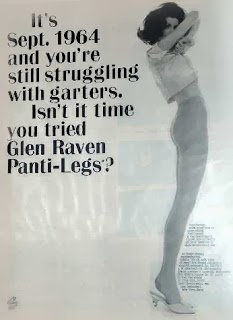
·        In 1959, Allen Gant Sr patented “Panti-Legs”. This was the birth of pantyhose – and women would finally be liberated from wearing stockings with suspenders and clips.  At this time, DuPont also invented Spandex – which would eventually allow hosiery to become stretchier, clingier, and better fitting.

·        The 1960s fashion for miniskirts required the widespread use of pantyhose as opposed to stockings, and also as a “modesty” garment; it also put legs up there, front and centre, and “tights” or novelty pantyhose became a fashion item rather than a basic staple. Tights in bright colours and even psychedelic patterns were commonly seen on the streets and in fashion magazines. While solid colours were most popular, crochet, glitter, motifs, and novelty fabrics were all very fashionable.


·        While a more relaxed, bare-legged look was common in the 1970s, hosiery was still big business. Many still subscribed to the belief that a “lady” wasn’t properly dressed without wearing hose – and, for more conservative or older women, at least, flesh toned hose sold well. These hose were hardly attractive, though – frumpy nude tones which were anything but discreet, worn with (ugh!) open toe shoes.

·        The early 1980s saw sheer pantyhose in various colours become popular – candy pinks, mint greens, white. Power-dressing women stuck to sheer black pantyhose.
·        Donna Karan, in partnership with Hanes, in 1987 introduced matte jersey black opaque tights, also offering them in browns and navy. The look took off in a big way – and stuck, especially as hemlines rose again in the early 1990s.

·        The mid 1990s again saw hosiery decline as bare legs were acceptable in a more relaxed dress code – even in winter.

·        Stockings and suspenders remain a big seller – as novelty, special occasion (such as wedding), or bedroom wear.

·        Today? Thanks to the likes of the Duchess of Cambridge, flesh toned pantyhose are enjoying a renaissance as classy, elegant, and not necessarily for old people. Today’s sheers truly are sheer, and fit like never before. There are even toeless hose – so there need never be another open toe shoe plus pantyhose horror again. Patterned and opaque tights are bestsellers, especially for the cooler months.


Legwear has come a very long way – and has never been better for fit, style, and comfort. Is your hosiery wardrobe up to the challenge?

Sunday, 5 January 2014

A Historical Look at Hosiery – Part 2

Continuing our historical look at hosiery ... did you know?

·        In the year 1609, William Lee travelled to France, seeking subsidies and a monopoly patent on his knitting machine from French King Henry IV. It was not granted, and Lee died penniless in Paris.

·        Even by 1696, stocking frames had to be smuggled out of England; the penalty at this time if caught doing so was a forty pound fine (a huge amount of money in those days) and any machines seized were confiscated.

·        In America during the Revolutionary war, the need for stockings was greatly enhanced. Most of the army’s needs for stockings were seen to by citizens who hand wove and knit for the troops.

·        In 1818, two English framework knitters successfully smuggled an old hosiery frame out of England and established themselves in the United States.

·        The 1800s were a busy time in the evolution of hosiery production. The first circular knitting frame was available in England in 1816; and by 1838 the US had a steam power driven hosiery machine. 1839 saw a US patent for a power driven circular knitting machine, and latch needles were patented in the US in 1850. By 1860, hosiery production in the Unites States had dramatically increased.

·        Between 1860 and 1900, wool was replaced as the fibre of choice for hosiery, being blended with cotton, then eventually being virtually overtaken by cotton. 

·        By 1929, the vast majority of women’s stockings were made of silk. Rayon was also eventually used as an alternative to the expensive silk.


·        The circular knitting machine was invented in the 1930s. This would lead to the eventual invention of the seamless stocking. Until about 1950, stockings had seams; by 1950, however, seamless stockings appeared, to the relief of women everywhere.


·        1938 saw the invention of nylon by DuPont. Stockings would never be the same! Better fitting, and not as baggy at the knees or ankles, nylon stockings quickly replaced their silk counterparts and sold out very quickly. Manufacturers could not keep up with the demand, and the Japanese silk market actually collapsed.

·        During World War II, hosiery for women was a luxury. Nylon was needed for tent and parachute production for the military. The only people with any access to nylon stockings were American soldiers – who used this to their advantage when wooing English and Australian women.  The absence of nylon stockings resulted in a lot of women choosing to brown their legs and draw a seam with an eyebrow pencil; certain make-up companies marketed "liquid stockings" for that specific purpose. At the end of World War II, in 1945, New York department store Macy’s sold out of its stock of fifty thousand pairs of nylon stockings in just six hours.


·        Spandex was invented in 1959, making stockings much more flattering and comfortable to wear.

·        Until the 1960s, stockings were held up by suspenders attached to a girdle, or by elasticised garters. But change was coming...


Stay tuned for the 1960s to the present day next time...

Monday, 9 December 2013

A Historical Look at Hosiery – Part 1

Hosiery, or “hose”, refers to legwear, or apparel worn specifically on the legs or feet. 

Traditionally made by a “hosier”, the fabrics used for hosiery are knitted and of varying thickness and weight. This thickness is termed “denier”.

Denier is a term which defines how much light will pass through the fabric. Lower deniers, between five and fifteen, describe hosiery which is sheer. Above forty denier, the fabric is dense; at one hundred denier, no light will pass through at all.

Most women and men will wear some form of hosiery; these days  the  term broadly covers stockings, pantyhose, knee highs, socks, leggings, tights, bodystockings, and even legwarmers. But where did it all begin?

Traditionally, hosiery was worn for warmth.

·        The term “hosiery” comes from the Anglo-Saxon “hosa”, meaning “tight legged trouser”. “Stocking” originates also from Anglo-Saxon; “stoka” meaning “stump”. “Sock” comes from the Latin, “soccus”, which was a soft indoor slipper.

·        Even Neolithic man knew how to spin yarn and fibres; in time cloth was woven and hand knitted. The first examples of knitting as we know it today date from ~1000AD; thought to have originated in Arabic nations, it was introduced to Britain by the 1200s.

·        A pair of hand knitted red wool socks was found in an ancient Egyptian tomb sometime between 400 and 500 AD. They tied by a cord at the top to hold them in place at the ankle.


·        Romans were documented by author Hesiod as having covered their legs with strips of leather or cloth tied on.

·        Charlemagne wore leg bindings in the period between 770 and 810 AD.

·        Young Venetian men in the 1300s wore silk leggings underneath short jackets. These leggings were usually brightly embroidered, and scandalised the older Venetians of the time.


·        Queen Elizabeth I received her first pair of silk stockings in 1560.


·        After the invention in 1598 of the first knitting machine by Englishman William Lee, hosiery was knitted from wool, silk, and cotton. Queen Elizabeth I was presented with a pair of black silk stockings, by which she was extremely impressed and requested more.  She deemed that the knitting machine was an English national treasure!


Stay tuned for Part 2...