Showing posts with label stockings. Show all posts

Monday, 20 July 2015

Hosiery – Luxurious Legs

Hosiery is luxury personified for legs. And one of the most famous hosiery manufacturers in Australia is Voodoo.

Voodoo Hosiery is one of Australia’s premium brands for stockings and pantyhose. They have supplied Australian women with hosiery for many years that is both innovative and stylish. Voodoo is renowned countrywide for high quality, great wearability, and sensual style.


Voodoo Hosiery was created for the first time in1972, when the company was launched by Leon Worth. Worth, at the time known as Australia’s “hosiery king”, had been involved in the stockings and pantyhose manufacturing and marketing industry since the 1950s.

Voodoo introduced the comfort brief to their pantyhose range in 1974; this was much more comfortable for women for everyday wear than the traditional stockings and suspenders that women had endured for decades. It also offered a much better line under clothing and suited the shorter styles worn at the time.

The Voodoo brand grew and evolved in the following decades. The first control top pantyhose range was released in 1999, eliminating the requirement to wear separate shape wear and facilitating a slim and smooth silhouette underneath clothing.

Opaque tights came onto the market in 2001 – and this was followed in 2002 by Voodoo’s first fashion colour and patterned range for enhanced personal style.

Voodoo is a pioneer in innovative pantyhose and stockings. Ladder control technology, which was invented and first marketed by Voodoo in 2009, minimised the ever-annoying tendency for sheer stockings to ladder, and allowed women to look polished and classy despite a snag in the pantyhose.


Voodoo Glow was launched in 2010; this was the ultimate in sensual, nude leg wear, which affords a sun kissed, and bare but perfect look.

Another landmark design for Voodoo was the introduction of the Voodoo boot tight in 2011. A sewn in ankle sock for warmth and extra comfort when wearing winter boots was a real innovation. 2011 also welcomed the popular Voodoo Voluptuous – designed to fit and flatter plus-size girls.

Voodoo has something for everyone: sexy stay-ups, sensuous sheers, opulent opaques and simple everyday basics. Pantyhose, fishnets, boot tights, vibrant fashion tights, stay ups, knee hi’s and stockings. Invite some Voodoo into your wardrobe!


Tuesday, 21 April 2015

Hose, Stockings, and a Century of Sheer Sexiness

There is nothing sexier than a woman slowly pulling up her stockings.  Those thin, leg-hugging garments make your legs look so soft and tanned.  But when did that all start?


Back in the late 1500s, William Lee of Nottinghamshire invented the first knitting machine and made the first machine-made seamed hose.  At the time, men of good families wore stockings and garters under their doublets.  It was not for women until the Victorian era.  Stockings were made of wool or silk until a revolutionary yarn was invented in 1912:  the rayon fibre, also called artificial silk.  Then, in the 1930s, nylon was created for the first time.  It was such a popular material that stockings quickly became known as nylons.  “Strong as steel, as fine as spiders web”, declared its inventors Du Pont, as they showcased it at the New York World Fair in 1939.


Nylons were an immediate success.  Women rushed out to buy them.  In Europe and in America, with the WWII restrictions, nylons could be had for a whopping $10 (a fortune in those days) on the black market.  While nylon is a strong fibre, it has no stretch, so manufacturers had to shape them and make stockings in many sizes so they would fit perfectly.


In 1959, Du Pont (yes, them again) came up with a new, stretchy fibre called lycra.  Goodbye baggy ankles, say hello to comfortable hosiery that fits!  Say also goodbye to the seam as circular knitting became the norm.  This was perfect timing as, with the 1960s, hems went up and mini-skirts became popular.  Hose, or as is what now called pantyhose, became more visible.  This created a demand for fun, colourful hose, in a variety of patterns.


Today, hosiery is enjoying a revival.  Its sex appeal makes it an essential item in your lingerie drawer.  At Undiewarehouse.com.au, we have the pleasure to offer over 200 different choices.  No matter which type you want, we have it.  We thrive to be your one-stop shop for the ultimate in high quality hosiery. 

We offer the best names in the industry such as Ambra in footless, no waist, body shapers, fishnets, ultra sheers, opaque and ladder resistant, control tights, and hipsters just to name a few.  We are proud to carry some amazing Razzamatazz pantyhose such as the curvaceous line in sheer and opaque .  We have a large collection of amazing stay-ups such as the Voodoo Killer Legs  that not only stay up but boasts a pretty lace border and a sensual aroma.

For an edgy and trendy look, why not try our leatherette leggings available in blue or silver?  These full-length leggings only need a slinky top and some high heels for you to go out on the town.  


No matter the look you want, we're sure to make you a very happy customer with our extensive lines of hosiery.

Monday, 2 March 2015

Queen Victoria’s Undies

In October 2014, royal bloomers belonging to Queen Victoria were auctioned in Ashford, UK. Along with her silk stockings and a chemise, they sold for a combined price of almost eight thousand British Pounds.


Queen Victoria ruled Great Britain and Ireland from 1837 (at just age eighteen) until 1901, and she was also Empress of India between 1876 and 1901. She remains the longest serving monarch in British history.

Dating from 1890, later in the queen’s life, the underwear was enormous and majestic in its proportions. The silk, split crotch drawers (as was the fashion of the time) had a waist measurement of fifty two inches (130cm) and the chemise accommodated a bust size of sixty six inches (165cm).  Considering the queen was only a very diminutive five feet tall, she was certainly rotund!

The bloomers bore the embroidered royal emblem monogram of Victoria Regina. The chemise and bloomers are the equivalent of today’s size thirty six – astounding proportions. The chemise has delicate buttons and frilled lace on the border
When Queen Victoria died, she had willed much of her clothing and undergarment collection to her servants who had loyally seen to her needs throughout her reign. Many items were distributed amongst her household. The bloomers had been in the possession of a family in Kent since at least the1920’s.


The buyer who won the bidding war for these garments is unknown but believed to be a memorabilia collector from Israel.

Another item of underwear belonging to Victoria and still in existence is her petticoat – again, dating from the 1890’s. It is of cream wool and exquisitely embroidered along the hem in beige silk, with thistles, shamrocks, roses, crowns, and her VR monogram. These symbolised Scotland, Ireland, and England, over which she ruled.

The auction was held in aid of a Guide Dog charity. Considering the fact that Queen Victoria was a lover of animals and had many dogs as companions, we believe that one may well have been amused at the sale of one’s bloomers for such a good profit!


Tuesday, 14 January 2014

A Historical Look at Hosiery – Part 3

Here is the conclusion of our historical look at hosiery ... did you know?

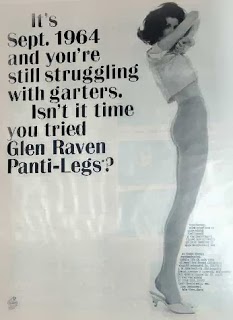
·        In 1959, Allen Gant Sr patented “Panti-Legs”. This was the birth of pantyhose – and women would finally be liberated from wearing stockings with suspenders and clips.  At this time, DuPont also invented Spandex – which would eventually allow hosiery to become stretchier, clingier, and better fitting.

·        The 1960s fashion for miniskirts required the widespread use of pantyhose as opposed to stockings, and also as a “modesty” garment; it also put legs up there, front and centre, and “tights” or novelty pantyhose became a fashion item rather than a basic staple. Tights in bright colours and even psychedelic patterns were commonly seen on the streets and in fashion magazines. While solid colours were most popular, crochet, glitter, motifs, and novelty fabrics were all very fashionable.


·        While a more relaxed, bare-legged look was common in the 1970s, hosiery was still big business. Many still subscribed to the belief that a “lady” wasn’t properly dressed without wearing hose – and, for more conservative or older women, at least, flesh toned hose sold well. These hose were hardly attractive, though – frumpy nude tones which were anything but discreet, worn with (ugh!) open toe shoes.

·        The early 1980s saw sheer pantyhose in various colours become popular – candy pinks, mint greens, white. Power-dressing women stuck to sheer black pantyhose.
·        Donna Karan, in partnership with Hanes, in 1987 introduced matte jersey black opaque tights, also offering them in browns and navy. The look took off in a big way – and stuck, especially as hemlines rose again in the early 1990s.

·        The mid 1990s again saw hosiery decline as bare legs were acceptable in a more relaxed dress code – even in winter.

·        Stockings and suspenders remain a big seller – as novelty, special occasion (such as wedding), or bedroom wear.

·        Today? Thanks to the likes of the Duchess of Cambridge, flesh toned pantyhose are enjoying a renaissance as classy, elegant, and not necessarily for old people. Today’s sheers truly are sheer, and fit like never before. There are even toeless hose – so there need never be another open toe shoe plus pantyhose horror again. Patterned and opaque tights are bestsellers, especially for the cooler months.


Legwear has come a very long way – and has never been better for fit, style, and comfort. Is your hosiery wardrobe up to the challenge?

Sunday, 5 January 2014

A Historical Look at Hosiery – Part 2

Continuing our historical look at hosiery ... did you know?

·        In the year 1609, William Lee travelled to France, seeking subsidies and a monopoly patent on his knitting machine from French King Henry IV. It was not granted, and Lee died penniless in Paris.

·        Even by 1696, stocking frames had to be smuggled out of England; the penalty at this time if caught doing so was a forty pound fine (a huge amount of money in those days) and any machines seized were confiscated.

·        In America during the Revolutionary war, the need for stockings was greatly enhanced. Most of the army’s needs for stockings were seen to by citizens who hand wove and knit for the troops.

·        In 1818, two English framework knitters successfully smuggled an old hosiery frame out of England and established themselves in the United States.

·        The 1800s were a busy time in the evolution of hosiery production. The first circular knitting frame was available in England in 1816; and by 1838 the US had a steam power driven hosiery machine. 1839 saw a US patent for a power driven circular knitting machine, and latch needles were patented in the US in 1850. By 1860, hosiery production in the Unites States had dramatically increased.

·        Between 1860 and 1900, wool was replaced as the fibre of choice for hosiery, being blended with cotton, then eventually being virtually overtaken by cotton. 

·        By 1929, the vast majority of women’s stockings were made of silk. Rayon was also eventually used as an alternative to the expensive silk.


·        The circular knitting machine was invented in the 1930s. This would lead to the eventual invention of the seamless stocking. Until about 1950, stockings had seams; by 1950, however, seamless stockings appeared, to the relief of women everywhere.


·        1938 saw the invention of nylon by DuPont. Stockings would never be the same! Better fitting, and not as baggy at the knees or ankles, nylon stockings quickly replaced their silk counterparts and sold out very quickly. Manufacturers could not keep up with the demand, and the Japanese silk market actually collapsed.

·        During World War II, hosiery for women was a luxury. Nylon was needed for tent and parachute production for the military. The only people with any access to nylon stockings were American soldiers – who used this to their advantage when wooing English and Australian women.  The absence of nylon stockings resulted in a lot of women choosing to brown their legs and draw a seam with an eyebrow pencil; certain make-up companies marketed "liquid stockings" for that specific purpose. At the end of World War II, in 1945, New York department store Macy’s sold out of its stock of fifty thousand pairs of nylon stockings in just six hours.


·        Spandex was invented in 1959, making stockings much more flattering and comfortable to wear.

·        Until the 1960s, stockings were held up by suspenders attached to a girdle, or by elasticised garters. But change was coming...


Stay tuned for the 1960s to the present day next time...

Monday, 9 December 2013

A Historical Look at Hosiery – Part 1

Hosiery, or “hose”, refers to legwear, or apparel worn specifically on the legs or feet. 

Traditionally made by a “hosier”, the fabrics used for hosiery are knitted and of varying thickness and weight. This thickness is termed “denier”.

Denier is a term which defines how much light will pass through the fabric. Lower deniers, between five and fifteen, describe hosiery which is sheer. Above forty denier, the fabric is dense; at one hundred denier, no light will pass through at all.

Most women and men will wear some form of hosiery; these days  the  term broadly covers stockings, pantyhose, knee highs, socks, leggings, tights, bodystockings, and even legwarmers. But where did it all begin?

Traditionally, hosiery was worn for warmth.

·        The term “hosiery” comes from the Anglo-Saxon “hosa”, meaning “tight legged trouser”. “Stocking” originates also from Anglo-Saxon; “stoka” meaning “stump”. “Sock” comes from the Latin, “soccus”, which was a soft indoor slipper.

·        Even Neolithic man knew how to spin yarn and fibres; in time cloth was woven and hand knitted. The first examples of knitting as we know it today date from ~1000AD; thought to have originated in Arabic nations, it was introduced to Britain by the 1200s.

·        A pair of hand knitted red wool socks was found in an ancient Egyptian tomb sometime between 400 and 500 AD. They tied by a cord at the top to hold them in place at the ankle.


·        Romans were documented by author Hesiod as having covered their legs with strips of leather or cloth tied on.

·        Charlemagne wore leg bindings in the period between 770 and 810 AD.

·        Young Venetian men in the 1300s wore silk leggings underneath short jackets. These leggings were usually brightly embroidered, and scandalised the older Venetians of the time.


·        Queen Elizabeth I received her first pair of silk stockings in 1560.


·        After the invention in 1598 of the first knitting machine by Englishman William Lee, hosiery was knitted from wool, silk, and cotton. Queen Elizabeth I was presented with a pair of black silk stockings, by which she was extremely impressed and requested more.  She deemed that the knitting machine was an English national treasure!


Stay tuned for Part 2...